What Your Child Actually Gets on PapaMarks: A Parent's Walkthrough (2026)
You can pay for a tutor for a year and never once know whether it worked. You can buy a revision subscription in September and have no way of telling, in March, whether it was ever opened. The reports say “progressing well.” The mock says otherwise. And the one person who could explain the gap is a sixteen-year-old who answers questions about school in single syllables.
That is the actual problem with paying for revision. Not the price — the blindness.
So this is not a sales page. It is a walkthrough of every screen your son or daughter would use, with the interactive parts running live on this page so you can operate them yourself before you decide anything. Rotate the models. Take the quiz and get one wrong on purpose. Read the marking. Then read the prices, which are further down and stated in full.
- 224,647 real Cambridge and Edexcel past-paper questions, of which 87,811 are written answers — the explain, describe and calculate questions where grades are actually decided.
- Written answers are marked like an examiner: a verdict, and where the method went wrong. Most platforms only mark multiple choice, because multiple choice is easy to mark.
- 6,794 complete past papers, 2001–2026, with mark schemes — available on every plan including the free one.
- 131 interactive tools — 3D models, virtual experiments, simulations. Two are open on this page right now.
- 730 revision note sets, 104,281 flashcards, and an AI tutor that answers at 3am.
- You get a progress page showing topic mastery and a predicted grade — which is the part that solves the blindness.
- Basic $35/month. Pro $62/month. There is a free tier: the first topic of every subject, plus every past paper.
Start with the thing that decides the grade
Ask a teacher where marks are lost and you will not hear “they did not know it.” You will hear that the student knew it and wrote it badly — described when the question said explain, gave the conclusion without the steps, used the everyday word where the mark scheme wanted the technical one.
Those are written answers, and they are most of the paper. They are also expensive to mark, which is why most revision sites quietly avoid them and sell you multiple choice instead. A multiple-choice question can be marked by comparing one letter to another letter. A written answer has to be read.
PapaMarks holds 87,811 written past-paper questions and marks them against the real mark scheme. Here is one, exactly as it comes back:
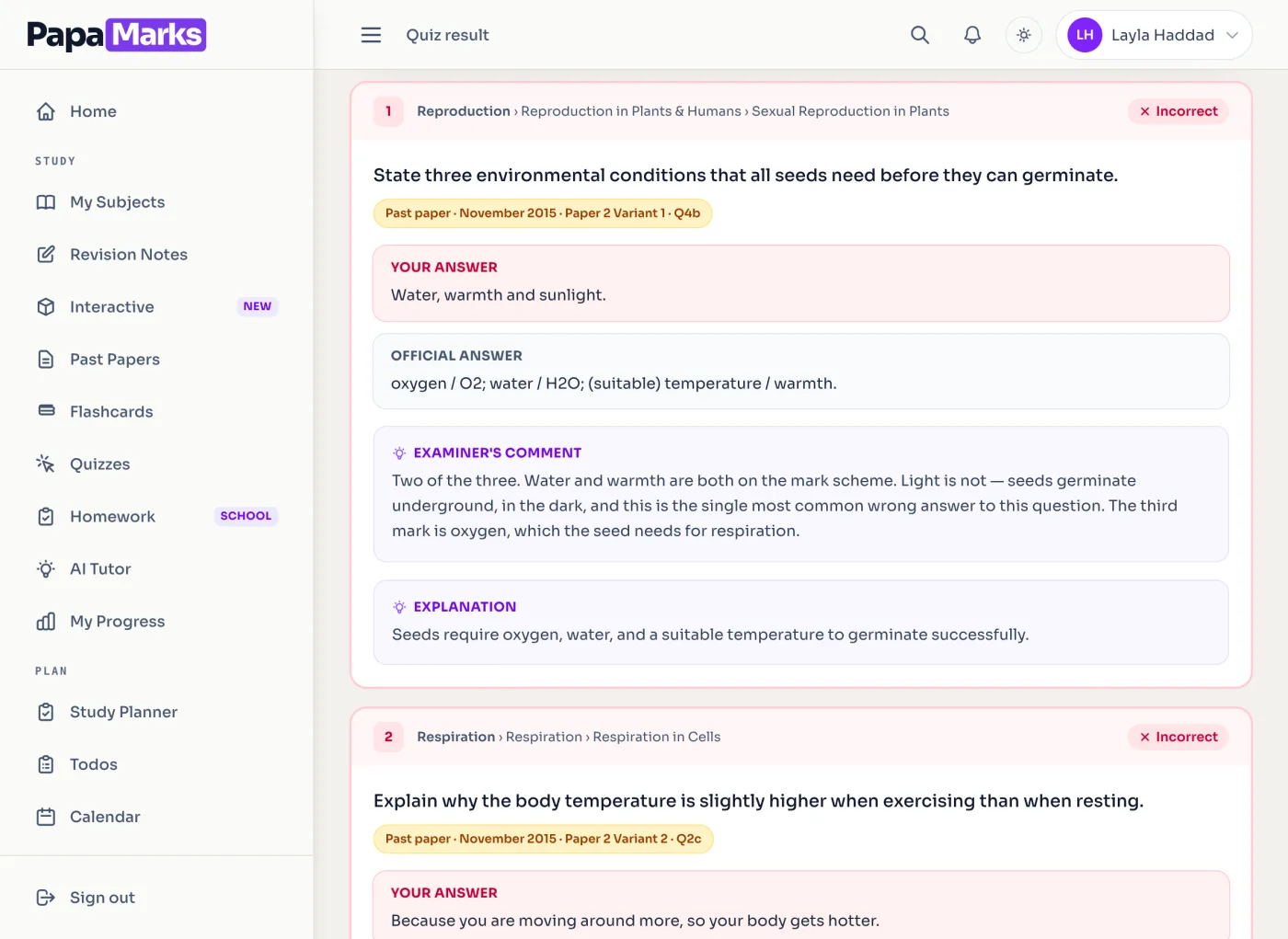
The answer was “water, warmth and sunlight.” Two of the three marks. The comment does not just say wrong — it says light is not on the mark scheme because seeds germinate underground in the dark, that this is the most common wrong answer to this question, and that the third mark is oxygen. That is the sentence a parent cannot write and a tutor charges by the hour for.
Notice what is on that screen besides the mark: the paper it came from, the session, the variant and the question number. Every question is a real one that was actually sat.
Take a quiz yourself. Get one wrong.
This is the live product, running in this page. Five genuine Chemistry 0620 past-paper questions. No account, nothing to install — and the point is not to score well, it is to answer one wrong and see what comes back.
Your child gets that on every question they answer, the moment they answer it — not next Tuesday when the marking comes back, by which point they have forgotten what they were thinking.
The night before the Biology paper
A diagram in a textbook is flat, still, and gone from memory in a minute. There are 131 interactive tools on PapaMarks — 3D models, virtual experiments, circuit builders, ray diagrams. Two of them are below, running live. Drag to rotate; tap any structure.
Every structure is labelled in English and Arabic, which matters more than it sounds: a student who learned the word in one language and sits the paper in the other loses marks that have nothing to do with biology.
Inside the account, the same tools sit against the syllabus topic they belong to, with the practice questions attached:
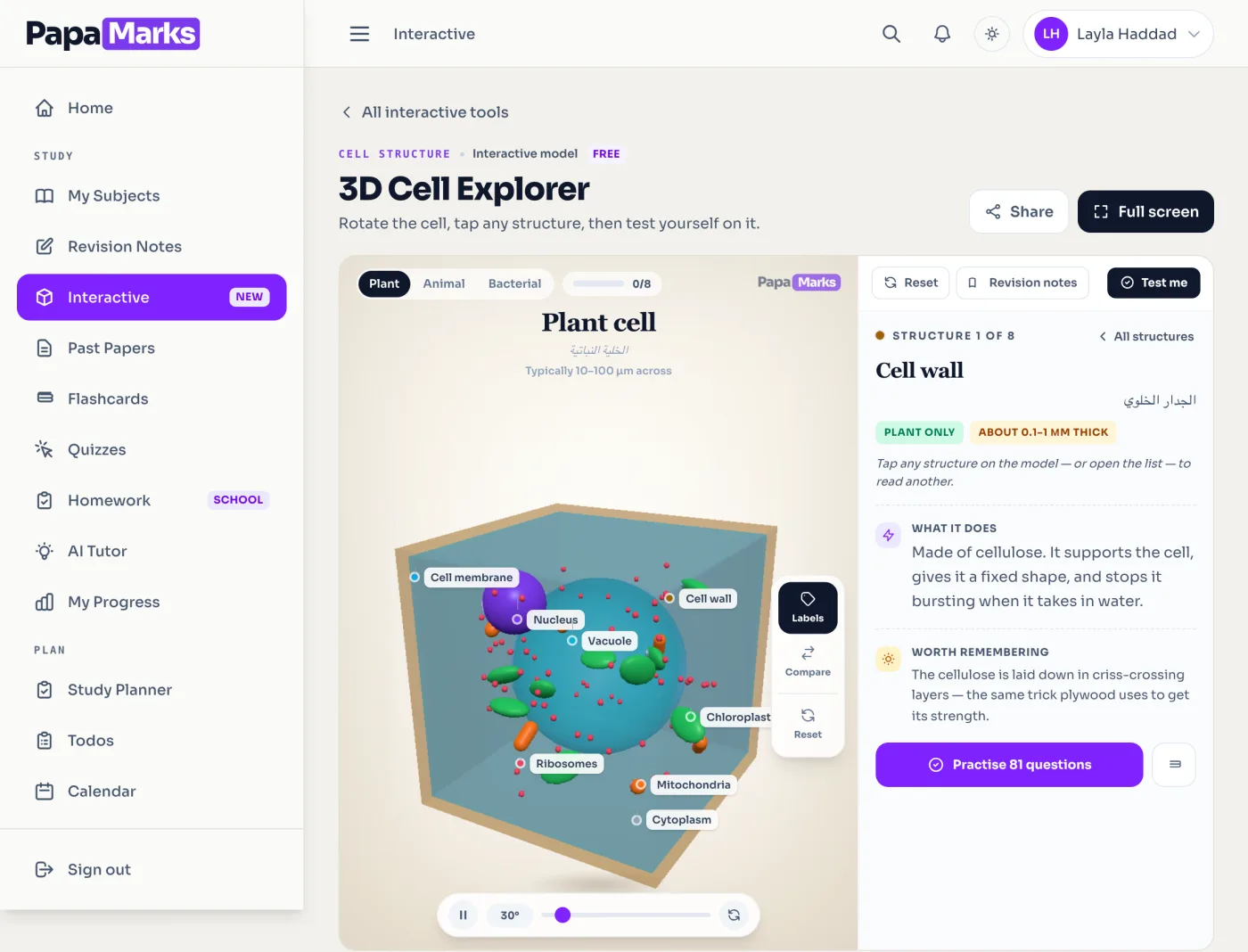
Not a toy bolted on the side. The panel explains what the structure does and what is worth remembering, and the button underneath goes straight to the 81 past-paper questions on that topic. Spin it, then be tested on it.
Half a revision note, so you can judge the writing
There are 730 note sets, written to the Cambridge syllabus topic by topic. Marketing copy about note quality is worthless, so here is an actual extract from the Circle Theorems note for Mathematics 0580 — read it and judge for yourself.
Geometry › Circle Theorems
The rule examiners actually test. Most circle-theorem marks are not lost on the geometry. They are lost on the reason. A diagram answer that gives the right angle and no justification scores one mark out of three, every time.
1. The angle at the centre is twice the angle at the circumference. Subtended by the same arc. The accepted wording is “angle at centre = 2 × angle at circumference” — and the phrase subtended by the same arc is what turns a guess into a reason.
2. Angles in the same segment are equal. Two angles standing on the same chord, on the same side of it, are equal. Students lose this one by not checking “same side”: on opposite sides you are in cyclic-quadrilateral territory and the angles are supplementary, not equal.
3. The angle in a semicircle is 90°. A special case of rule 1, because the angle at the centre is a straight line. Write “angle in a semicircle” as the reason; “because it is a right angle” is describing the answer, not justifying it.
4. Opposite angles of a cyclic quadrilateral add to 180°. All four vertices must be on the circumference — check that before you use it. This is the single most commonly misapplied theorem on the paper.
5. A tangent meets a radius at 90°. And two tangents from the same external point are equal in length, which turns the figure into an isosceles triangle…
Notes are organised the way the syllabus is, not the way a textbook is — so a student revising one topic gets one page, not a chapter:
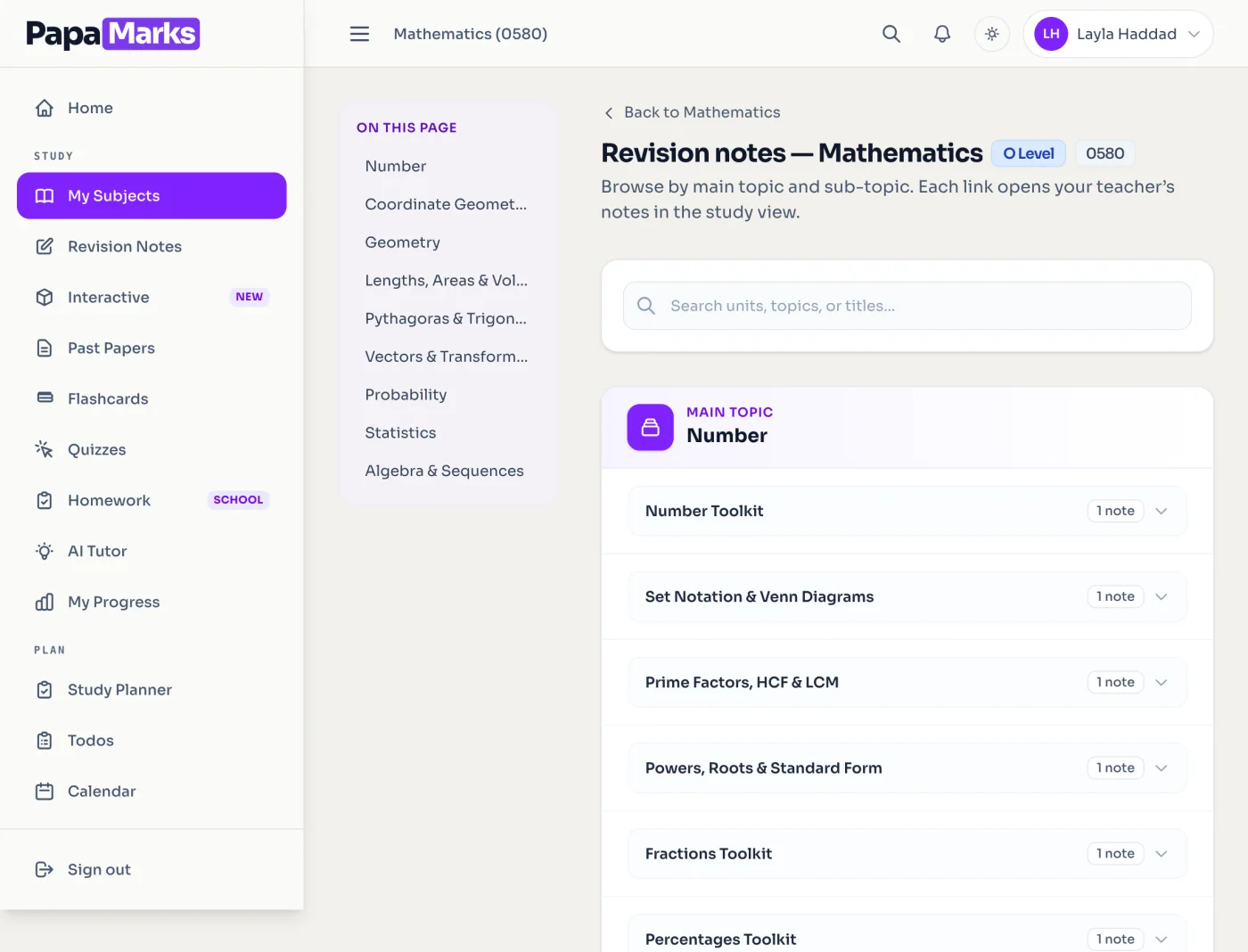
Every strand of the syllabus, with its topics under it. Revision that follows the specification rather than a book’s chapter order — which is what a student needs in the last six weeks.
The past papers, and why they are not the hard part
6,794 complete past papers, from 2001 to 2026, Cambridge and Edexcel, each with its mark scheme. These are available on every plan, including the free one — we do not think charging for public documents is a business.
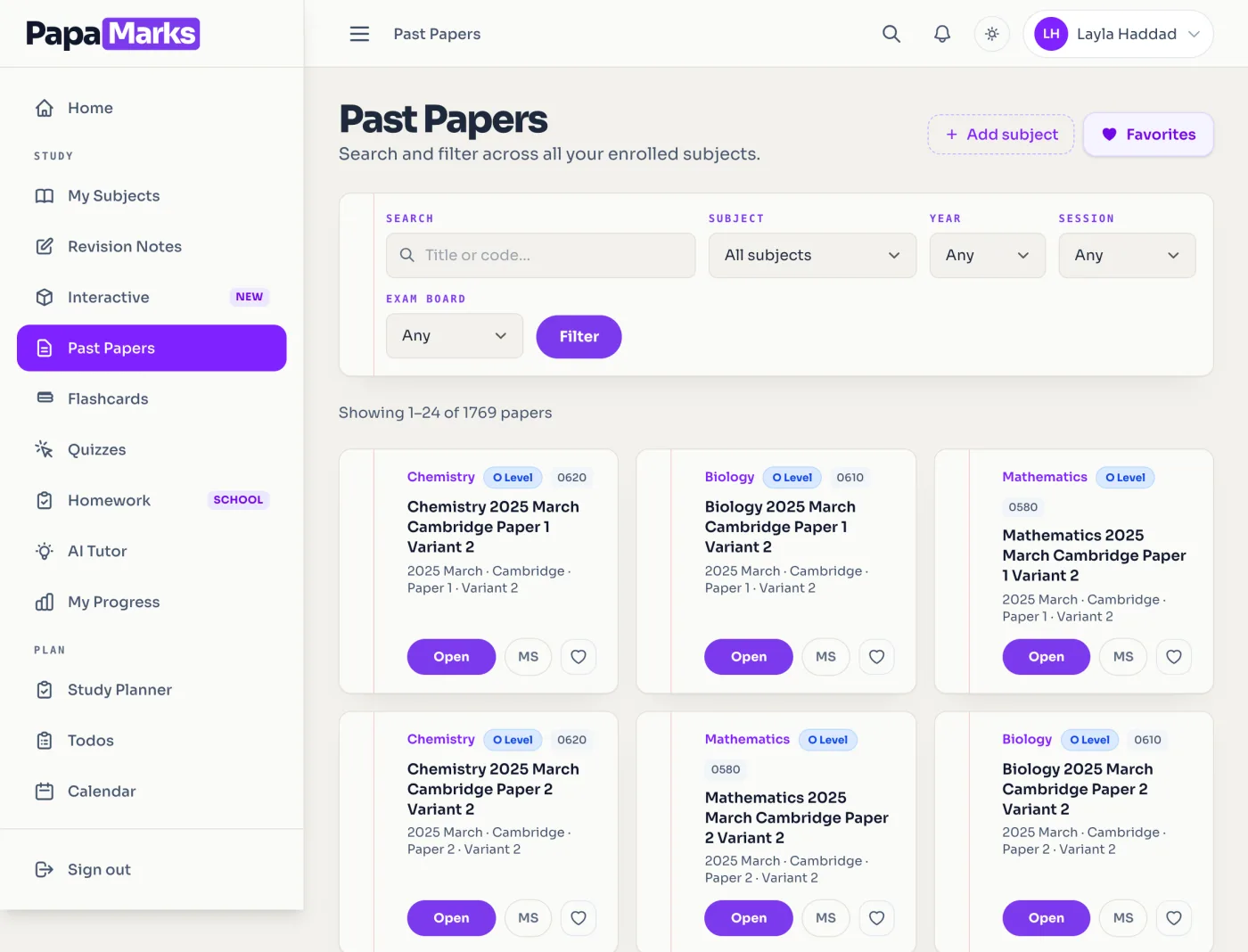
Filtered the way revision actually works — by subject, year, session, variant and board. Every paper has its mark scheme beside it.
Here is the honest part. A past paper your child downloads and never marks teaches them almost nothing. It feels like work, it fills an evening, and it produces no information. The value is not in the PDF, which anyone can get from the board’s own website. It is in what happens after the last question — and that is the difference between a paper archive and this.
Flashcards, for the facts that just have to be known
104,281 flashcards, generated from the syllabus and scheduled by spaced repetition, so cards a student keeps getting wrong come back sooner. Tap one to flip it:
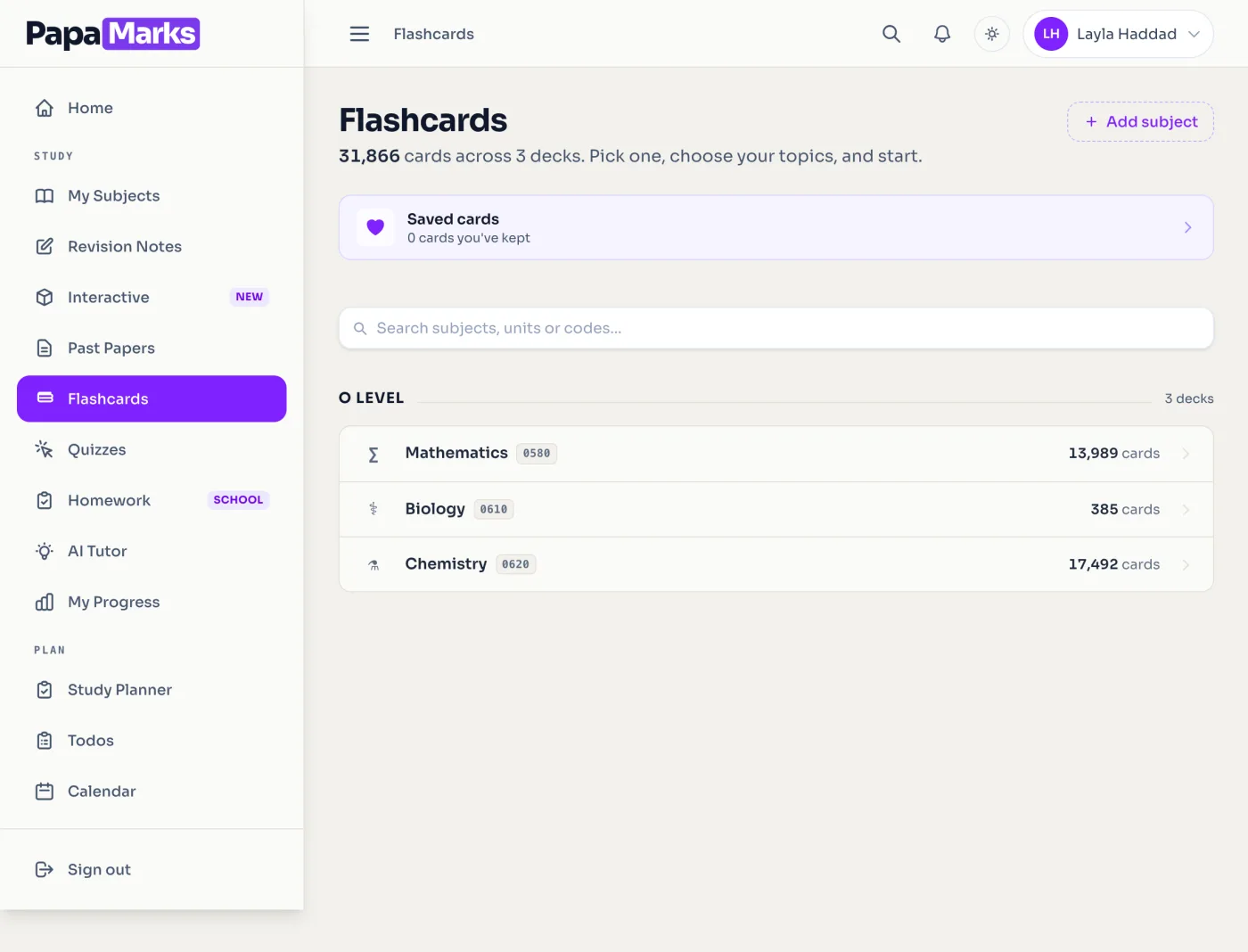
Decks per subject, cards per topic. A student taking three subjects sees only their three — not a library of 104,281 to wade through.
The tutor that is awake at 3am
Revision does not happen at civilised hours, and the moment a student is actually stuck is the moment they need an answer. The AI tutor is on every topic, in English or Arabic, and will take a photograph of handwritten working and mark it step by step.
Below is a real exchange, replayed — the live tutor needs a login, so unlike everything else on this page it is not running here. Everything in it is what the tutor actually returns.
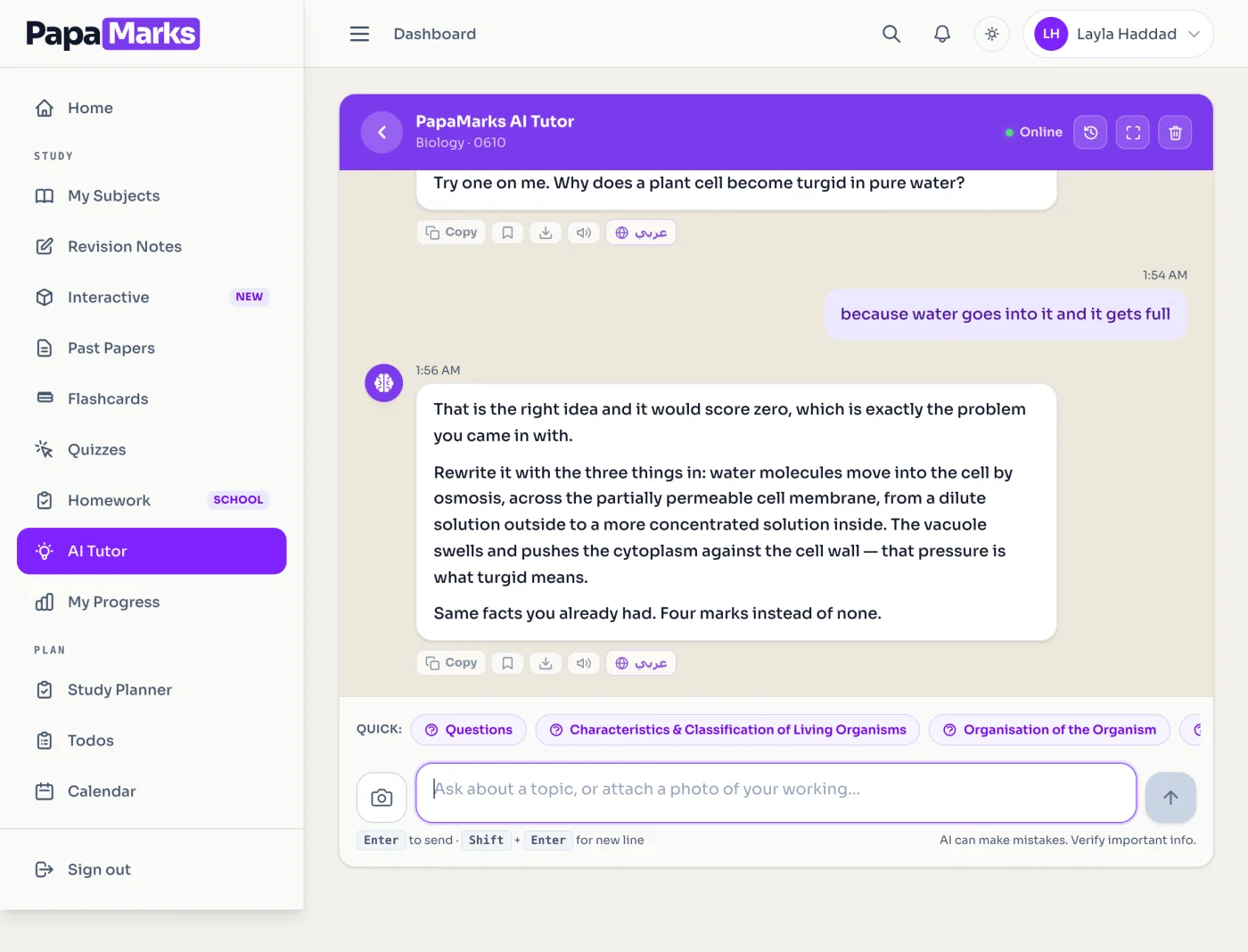
The camera icon is the part students use most. Photograph the working, get it marked line by line. The عربي button switches the whole reply to Arabic without changing the question.
And now the part that is actually for you
Everything above is for your child. This screen is for you — it is the answer to “is any of this working?”, and it is the reason a subscription is different from a pile of PDFs.
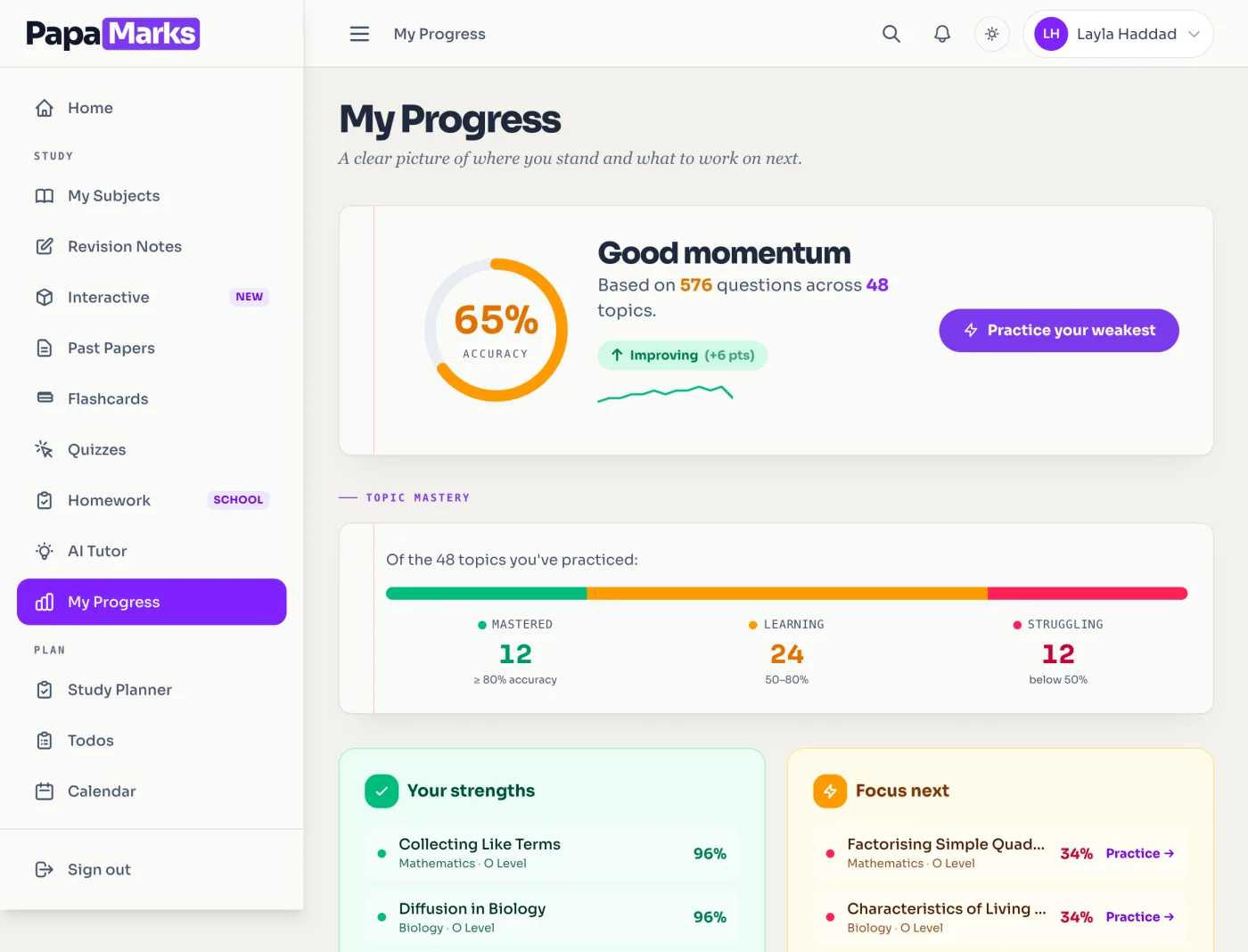
Accuracy, direction and the named topics. Not “progressing well” — 65% across 576 questions, improving by six points, twelve topics mastered and twelve still struggling, with the weak ones named and a button that starts practice on them. This is a conversation you can have at dinner without an argument, because it is about a topic rather than about effort.
That last point is worth sitting with. Most arguments about revision are really arguments about whether the child is trying. A page that says Factorising Simple Quadratics, 34% moves the conversation somewhere it can actually go.
But will they open it?
The fair question, and the graveyard of every educational subscription ever bought. There is no honest answer that guarantees it. What there is: a daily mission, a streak, trophies, and live quizzes their teacher can run in class — the same mechanics that keep them on the apps they do open.
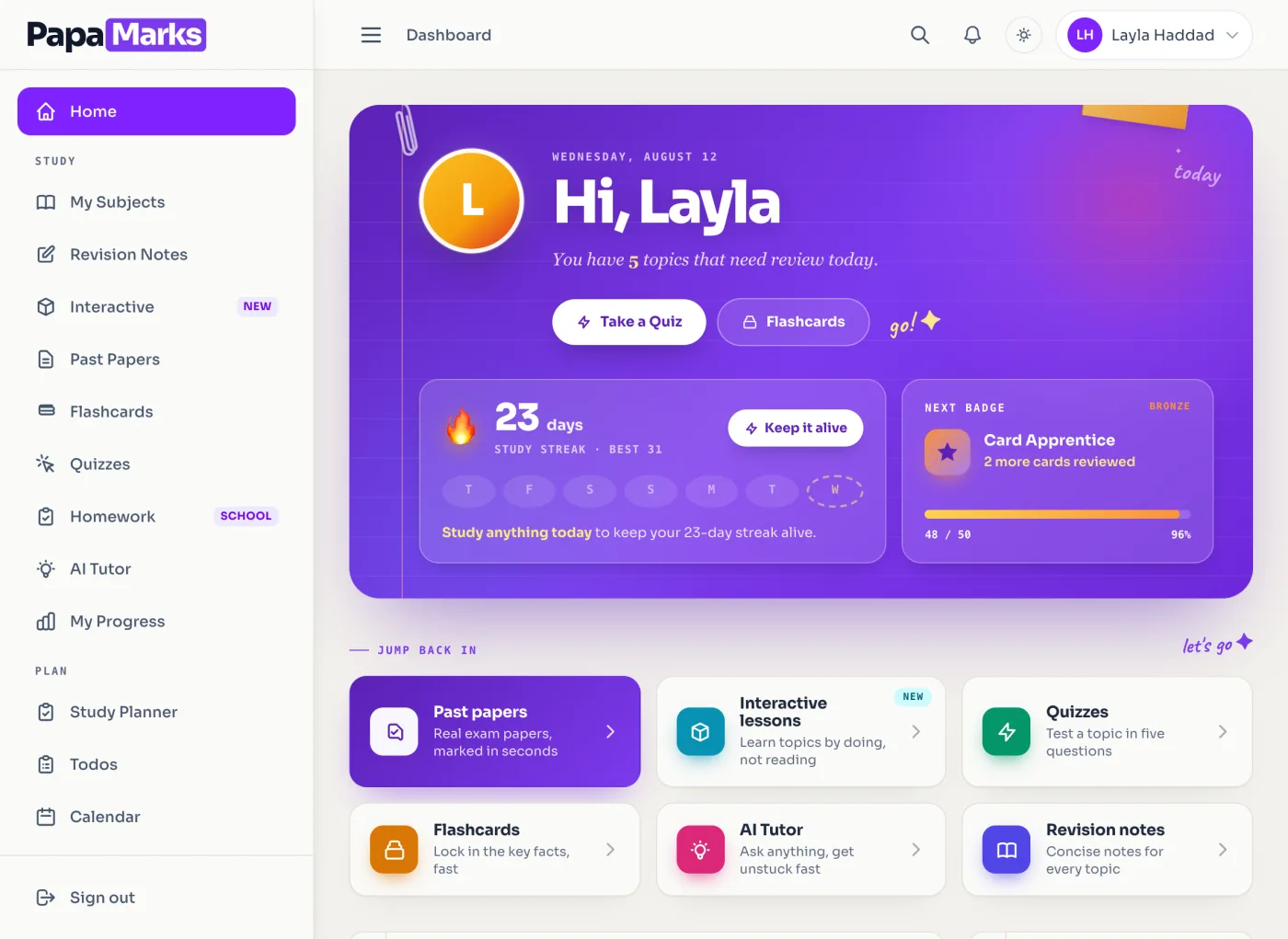
Twenty-three days, and five topics due today. The streak is doing exactly what streaks do. Whether that is education or psychology is a fair argument — but a student who opens the app is a student who revises, and one who does not is paying for nothing.
What it costs
Stated in full, because a page that shows you everything and then hides the price has told you something about itself.
- The first topic of every subject, in full
- All 6,794 past papers with mark schemes
- Flashcards, quizzes and the study planner
- Two interactive tools in every section
- 5 AI tutor messages a month
- Every topic, in all 25 subjects
- Multiple-choice past-paper practice, marked instantly
- All 730 note sets and 104,281 flashcards
- All 131 interactive tools
- Predicted grade and the progress page
- Everything in Basic
- 87,811 written past-paper questions, marked like an examiner
- Photograph handwritten working and have it marked
- Unlimited AI tutor on every topic
- Worked solutions and answer explanations
Prices are in US dollars, billed monthly, cancellable from the account at any time. The difference between Basic and Pro is one thing and it is the thing this whole page is about: written marking. If your child’s problem is coverage, Basic is enough. If their problem is that they know it and keep losing marks anyway, Basic will not fix that.
The evidence behind the numbers on this page
224,647 questions, of which 87,811 are written answers with a mark scheme, across 3,790 topics and 25 subjects.
- Method
- Direct row counts from the live question bank, excluding disabled questions. The written count additionally requires an official answer and a syllabus topic, because a question with neither can never be marked or reached — counting the raw question type overstates it by around 7,000.
- Source
php artisan site:stats, run against production.- Date
- 11 August 2026. These figures move upward as content is imported; the platform derives them at page-render time rather than hardcoding them.
6,794 complete past papers spanning 2001 to 2026, Cambridge and Edexcel, each with its mark scheme, available on every plan.
- Method
- Count of materials categorised as past papers; the year range is the minimum and maximum paper year in that set. Free access to papers is a platform-wide setting, not a promotional offer.
- Source
php artisan site:stats; plan contents from the published pricing page.- Date
- 11 August 2026.
Questions parents actually ask
What does PapaMarks cost?
Which exam boards and subjects does it cover?
How is this different from a free past-paper website?
Can I see whether my child is actually using it?
Does this replace a private tutor?
What age is it for?
How do I cancel?
What to do with this page
Do not take our word for the quality of any of it. The quiz above is real, the 3D models above are real, the note extract above is real and the screenshots are of the actual product with an actual student’s history in it. Scroll back up and use them.
Then, if it is worth trying, start on the free tier — the first topic of every subject and every past paper, at no cost — and see whether it gets opened before you pay for anything.
Reading this in Arabic? النسخة العربية من هذه الجولة covers the same ground for families in Jordan and the Gulf.
Related reading: a parent’s guide to IGCSE in Jordan · does my child need a tutor? · the seven best IGCSE revision websites, compared honestly
Put this into practice on real papers
6,822+ past papers, flashcards and an AI tutor for O Level, AS & A2. The open plan covers the first topic of every subject, plus every past paper.
Start practising →