You Revised for Six Hours and Got a C. Here Is What You Were Missing.
You revised for six hours. You came out of the mock with a C. Someone in your class revised for two and got an A, and the difference was not intelligence and it was not effort.
It was that they knew what the mark scheme wanted and you did not.
Here is the fastest way to prove that to yourself. Five real Chemistry 0620 past-paper questions, live in this page, marked the second you answer. Do not try to score well — pick one you are unsure about and watch what comes back.
That is the whole idea. Not a video of someone explaining chemistry. A question, an answer, and a reason — in the two seconds while you still remember what you were thinking.
- 224,647 real Cambridge and Edexcel past-paper questions, tagged to the exact syllabus topic they came from.
- 87,811 of them are written answers — describe, explain, calculate — and they get marked like an examiner marks them, with the reason.
- 6,794 whole past papers, 2001–2026, with mark schemes. Free on every plan, including the one that costs nothing.
- 131 interactive tools. Three of them are running further down this page — drag them around.
- 730 note sets and 104,281 flashcards, both built from the syllabus rather than from a textbook.
- An AI tutor that will mark a photo of your handwriting at 3am, and a page that tells you which topic to revise next instead of you guessing.
Why you lose marks on things you actually know
Open any mark scheme. Not the paper — the mark scheme. You will notice it does not award marks for being right. It awards marks for specific words appearing in a specific order.
Describe wants what happens. Explain wants why, and gives you nothing for what. State wants two words and punishes you for writing a paragraph, because the paragraph costs you four minutes you needed on question 7. That is the game, and nobody tells you the rules — they tell you to revise harder.
Here is one of yours, marked. Real question, real mark scheme, real answer:
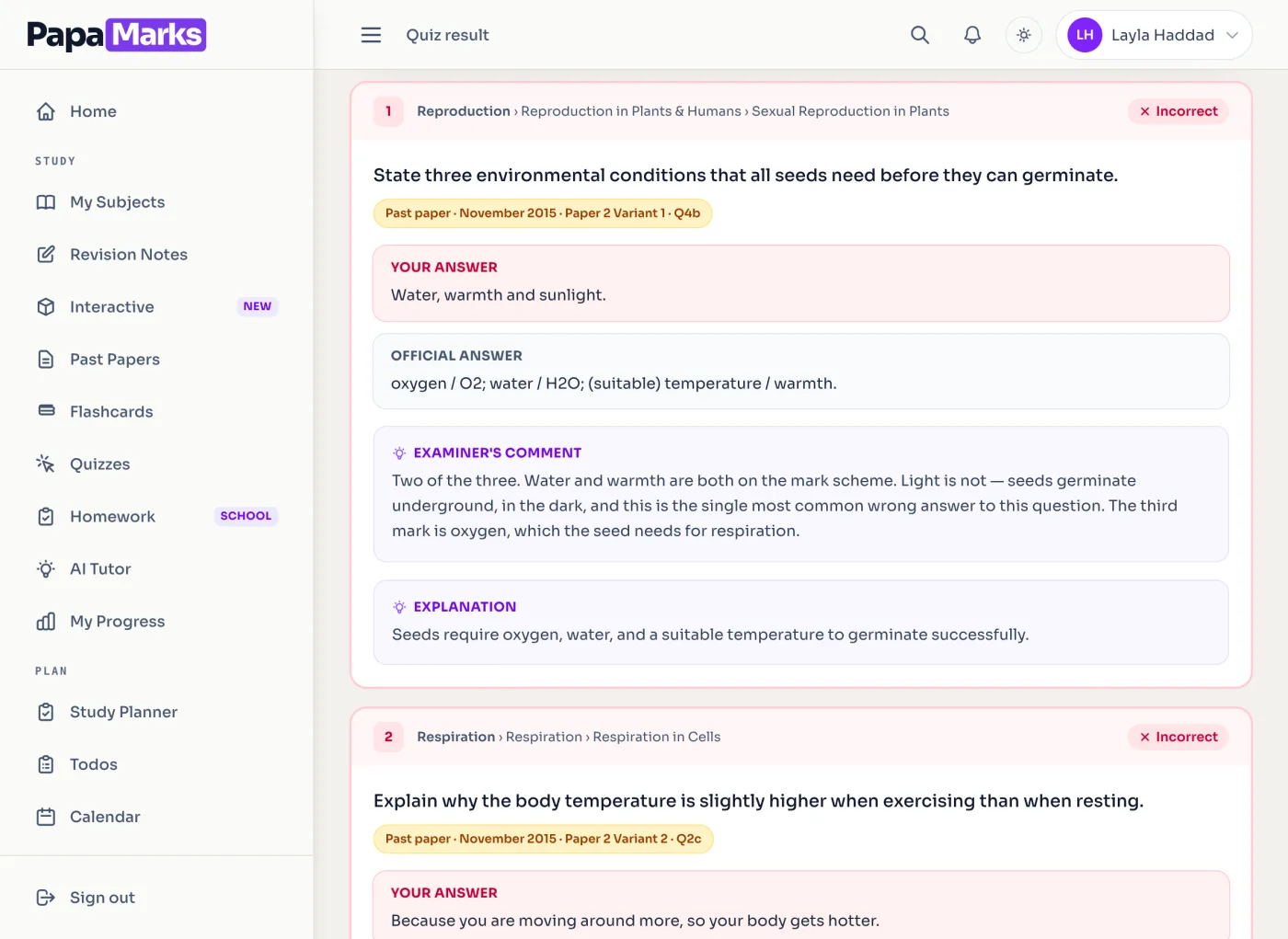
“Water, warmth and sunlight” — two marks out of three. And the comment tells you why light is wrong (seeds germinate underground, in the dark), that it is the most common wrong answer on this question, and that the third mark was oxygen. You will never write sunlight again. That is what marking is for, and it is the thing a downloaded PDF cannot do.
87,811 of the questions in here are written ones. Most revision sites only give you multiple choice, and they will tell you it is because multiple choice is efficient. It is because multiple choice is cheap to mark.
The 3D models. Drag them.
You have looked at the same flat cell diagram in the same textbook nine times and you still cannot label it under pressure. That is not a memory problem, it is a flatness problem — a still picture gives your brain nothing to hold on to.
All three of these are the real tools, running in this page. No account, no download. Drag to spin, tap any structure to see what it does and what the syllabus expects you to say about it.
Switch between plant, animal and bacterial with the tabs, then hit “Test me” and see whether it stuck. The comparison is the exam question — which structures does a plant cell have that an animal cell does not — and this answers it in about four seconds of spinning.
The one everybody gets wrong is which side is thicker and why. Spin it and the answer stops being a sentence you memorised and starts being a shape you have seen — the left ventricle wall is thicker because it pumps to the whole body, not just to the lungs.
Every label is in English and Arabic. If you learned a structure in one language and sit the paper in the other, that gap is worth real marks — and this closes it without you having to think about it.
There are 131 of these, not three: titration you can run without breaking anything, circuit builders where the current recalculates as you drag, ray diagrams, enzymes, DNA. Inside your account each one sits on its syllabus topic with the past-paper questions attached, so you spin it and then get tested on it:
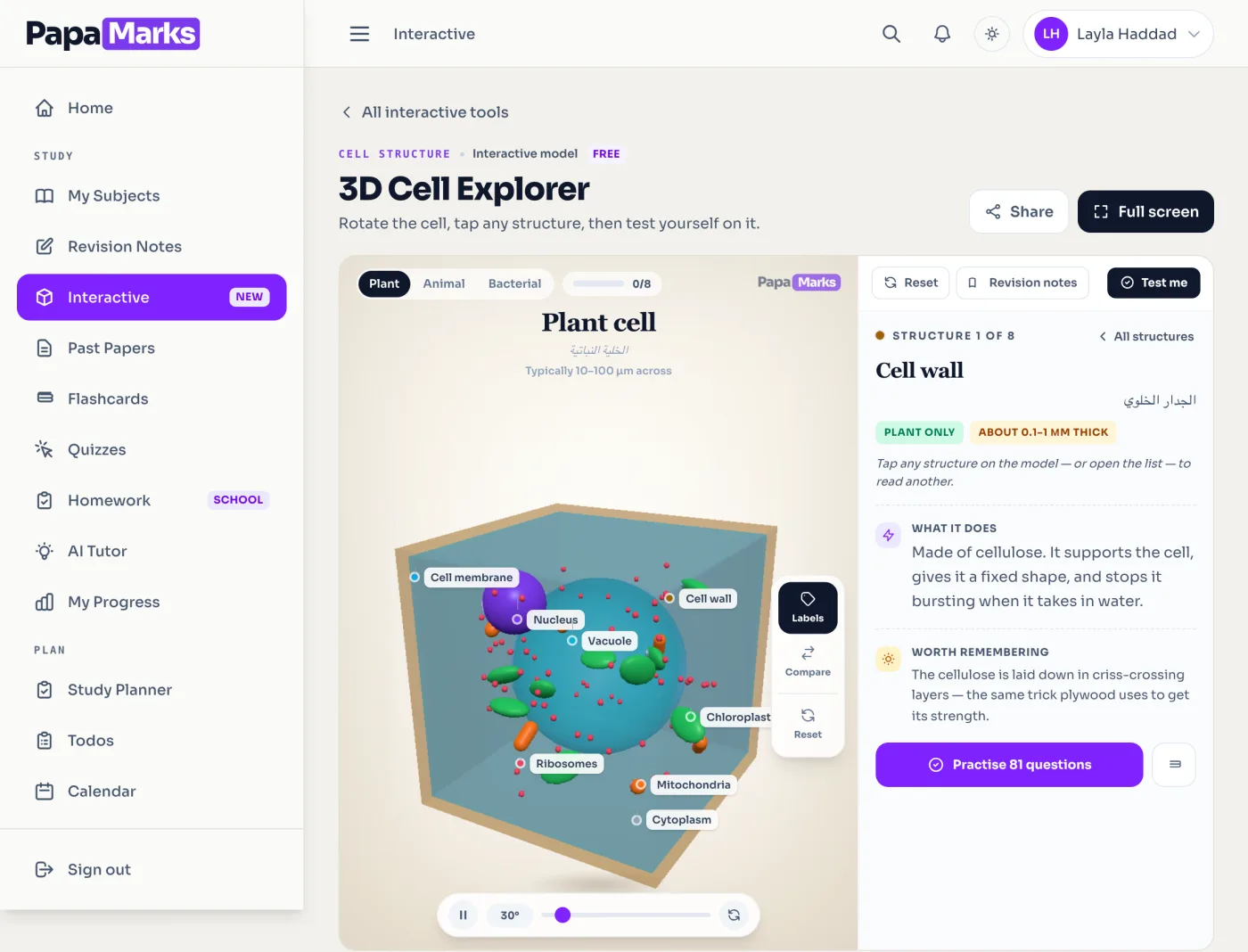
“Practise 81 questions” is the button that matters. Looking at a model feels like revision and mostly is not. Looking at it and then being asked about it is.
How many past papers should you actually do?
Fewer than you think, and properly rather than quickly.
There are 6,794 complete past papers in here, 2001 to 2026, Cambridge and Edexcel, every one with its mark scheme, and they are free on every plan including the one that costs nothing. So take this seriously when it comes from the people giving them away: a past paper you do not mark is close to worthless.
Three papers marked properly — where you find out which command word you misread and which topic keeps costing you — beat twelve papers done in an evening and never looked at again. The twelve feel more like work. That is the trap.
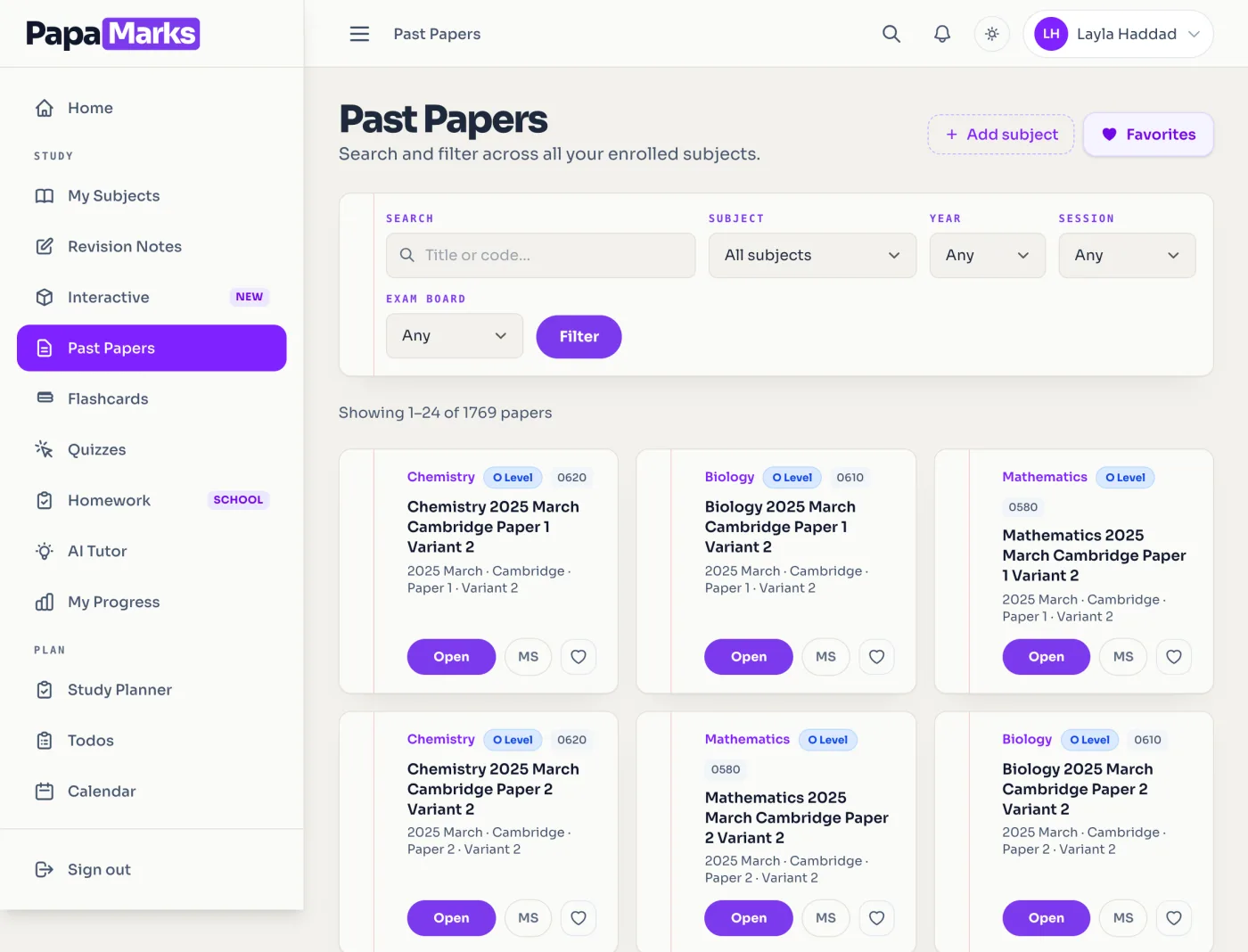
Filter by year, session, variant and board — and every question inside these is answerable on screen, written ones included, so the marking happens whether or not you have the discipline to do it yourself.
Notes that are the syllabus, not a chapter
730 note sets, written against the Cambridge specification topic by topic. Rather than claim they are good, here is half of a real one — Circle Theorems, Maths 0580. Read it and decide:
Geometry › Circle Theorems
Where the marks actually go. Most circle-theorem marks are not lost on the geometry. They are lost on the reason. An answer with the right angle and no justification scores one out of three, every single time.
1. The angle at the centre is twice the angle at the circumference. Subtended by the same arc. The accepted wording is “angle at centre = 2 × angle at circumference” — and the phrase subtended by the same arc is what turns a guess into a reason.
2. Angles in the same segment are equal. Two angles standing on the same chord, on the same side of it. People drop this one by not checking “same side”: on opposite sides you are in cyclic-quadrilateral territory and they are supplementary, not equal.
3. The angle in a semicircle is 90°. A special case of rule 1, because the angle at the centre is a straight line. Write “angle in a semicircle” as your reason; “because it is a right angle” describes the answer instead of justifying it, and scores nothing.
4. Opposite angles of a cyclic quadrilateral add to 180°. All four vertices must be on the circumference — check before you use it. This is the most commonly misapplied theorem on the paper.
5. A tangent meets a radius at 90°. And two tangents from the same external point are equal in length, which quietly turns the figure into an isosceles triangle…
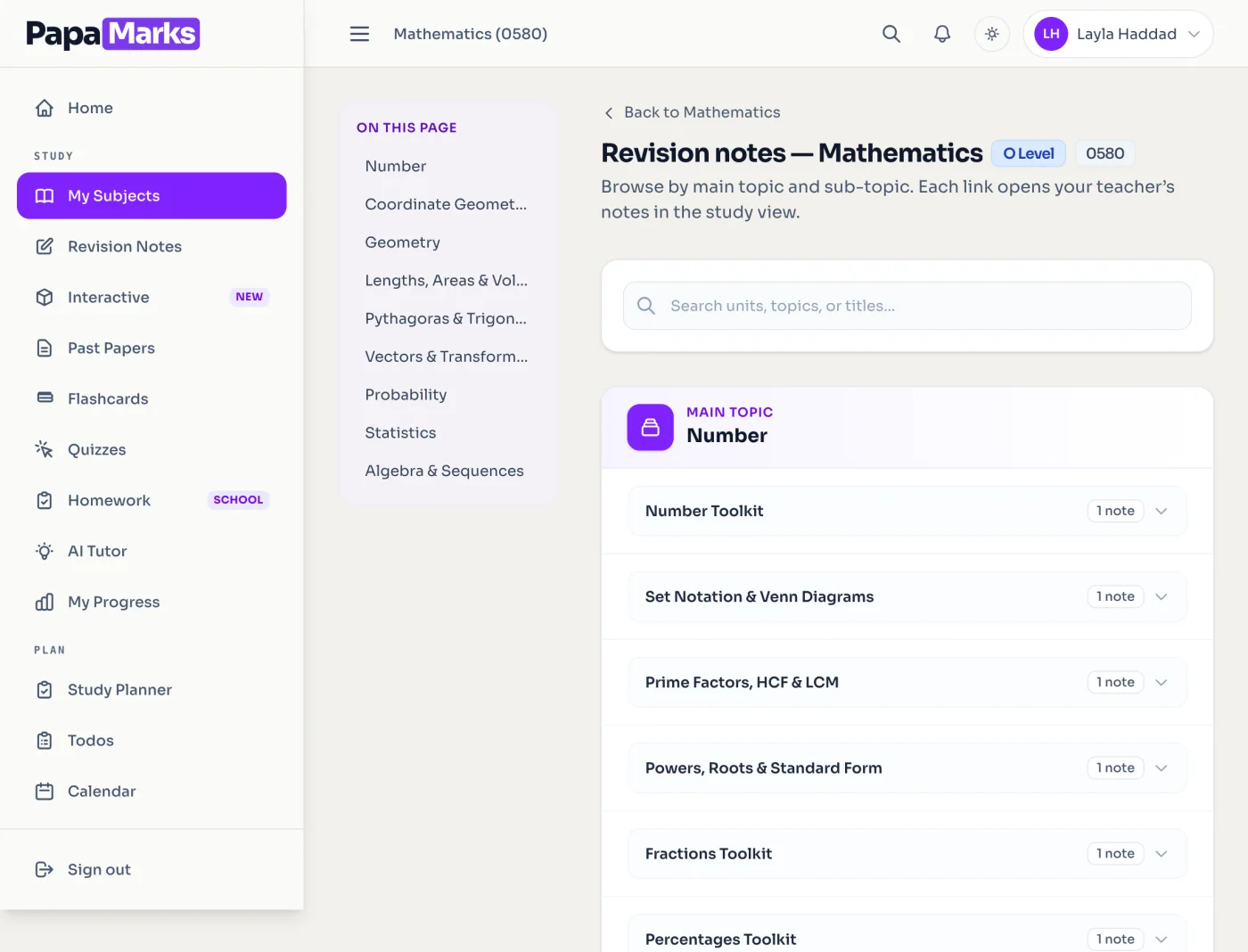
Organised the way the exam is, not the way a textbook is. When you have six weeks left you do not want a chapter. You want the one topic you keep failing.
Flashcards, for the stuff that is just memorising
104,281 cards, generated from the syllabus and scheduled by spaced repetition — which in practice means the ones you keep getting wrong come back sooner and the ones you know stop wasting your time. Tap one:
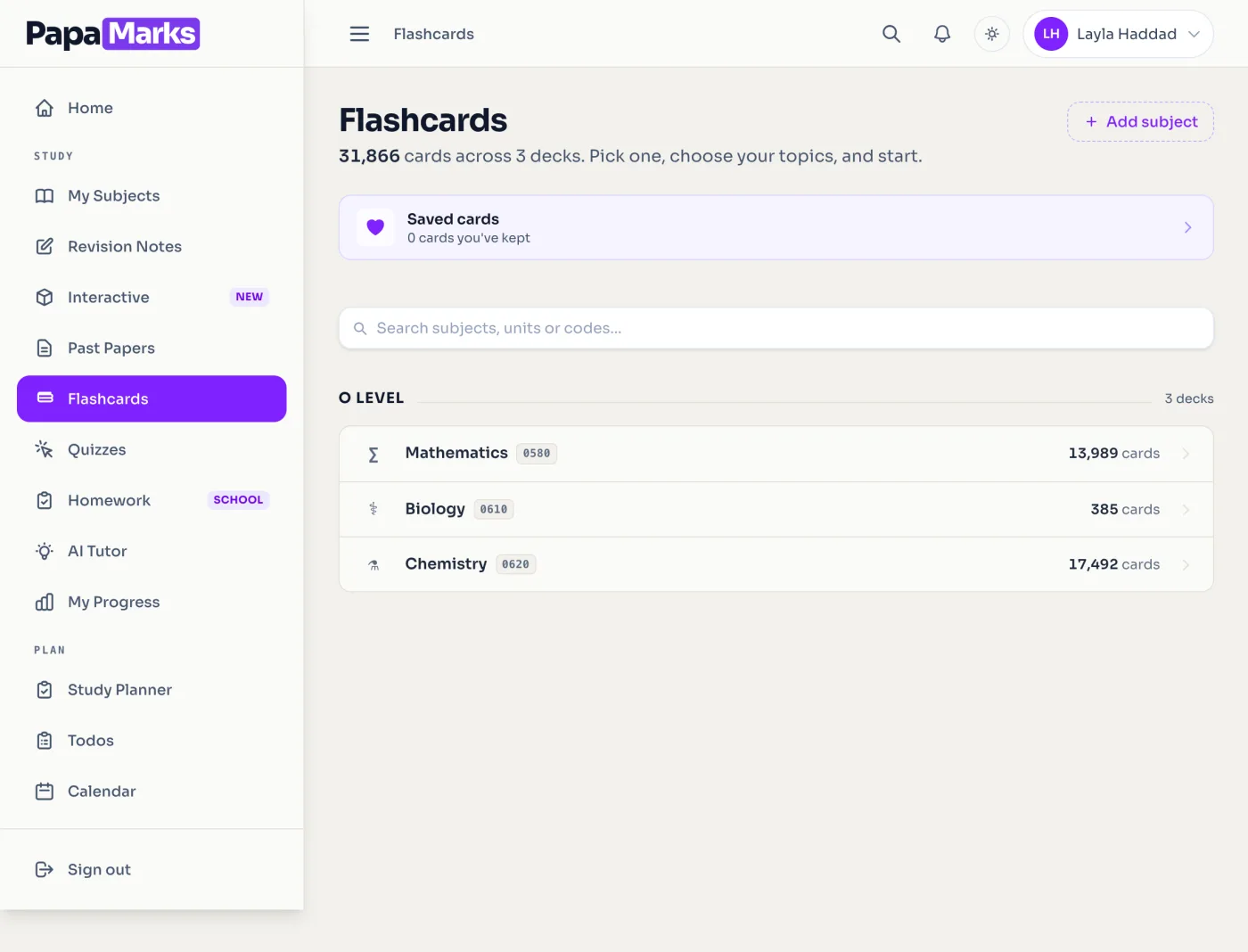
Only your subjects. You never see the other hundred thousand cards.
The 3am problem
The moment you are actually stuck is never during school hours. It is the night before, on one question, and there is nobody to ask.
The AI tutor covers every topic, answers in English or Arabic, and — the part people use most — you can photograph your handwritten working and it marks it line by line, so you find out where the method broke rather than just that the answer was wrong.
Below is a real exchange, replayed. Unlike the quiz and the models above, this one is not live — the tutor needs a login. Everything in it is what it actually says:
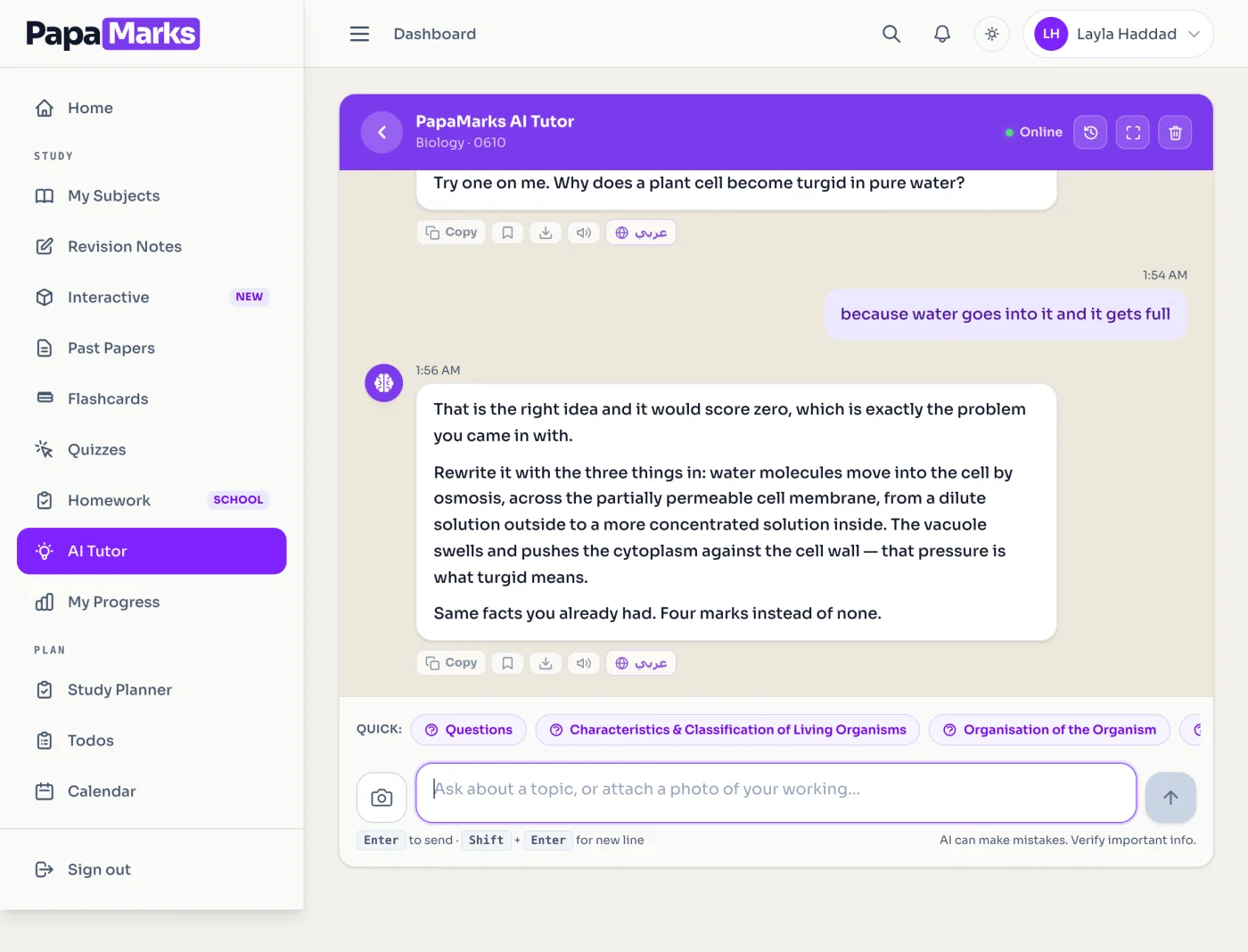
The camera icon and the عربي button are the two nobody expects. Photograph the working, get it marked step by step. Switch the whole reply to Arabic without retyping the question.
Stop guessing what to revise next
The worst part of revision is not the work. It is opening a folder of nine subjects at 8pm with no idea which one is actually costing you a grade, picking the one you like most, and revising something you already know.
This is the page that ends that argument with yourself:
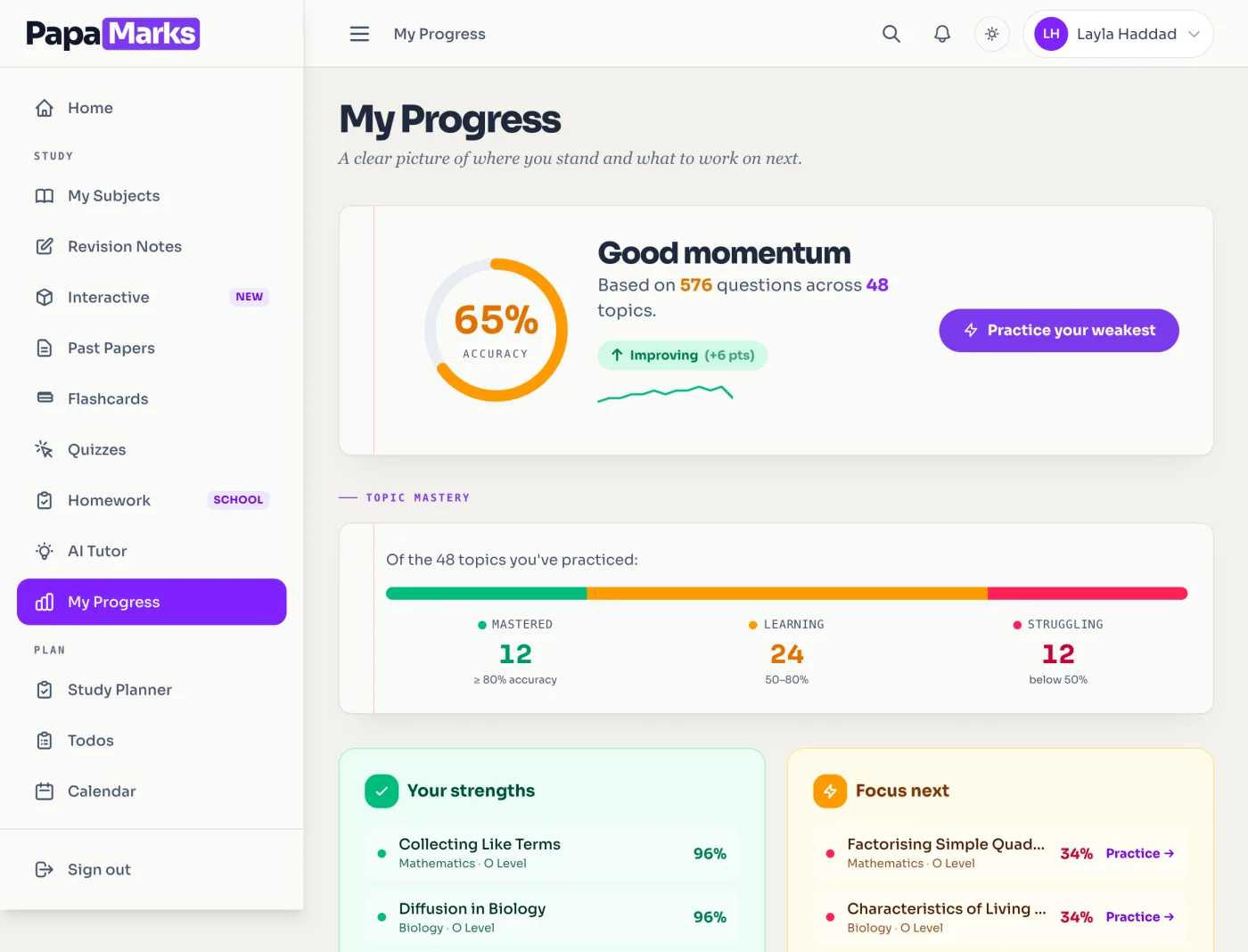
Twelve topics mastered, twelve struggling, and the weak ones named with a button that starts practice on them. Not a vibe about how revision is going — Factorising Simple Quadratics, 34%. That is tonight decided for you in about three seconds.
It also carries a predicted grade, worked from what you actually get right rather than from how you feel about the subject. Sometimes that is a relief. Sometimes it is the wake-up call, which is more useful.
And the bit that keeps you coming back
Being honest about this: the reason most revision apps fail is not that they are bad. It is that you open them twice in September and never again.
So there is a streak, a daily mission, trophies, and live quizzes your teacher can run in class where the whole room joins from their phones. It is the same machinery as the apps you already open without thinking. Whether that is a noble way to get you revising is a fair question — but a streak you do not want to break has got more people through a Chemistry paper than willpower ever has.
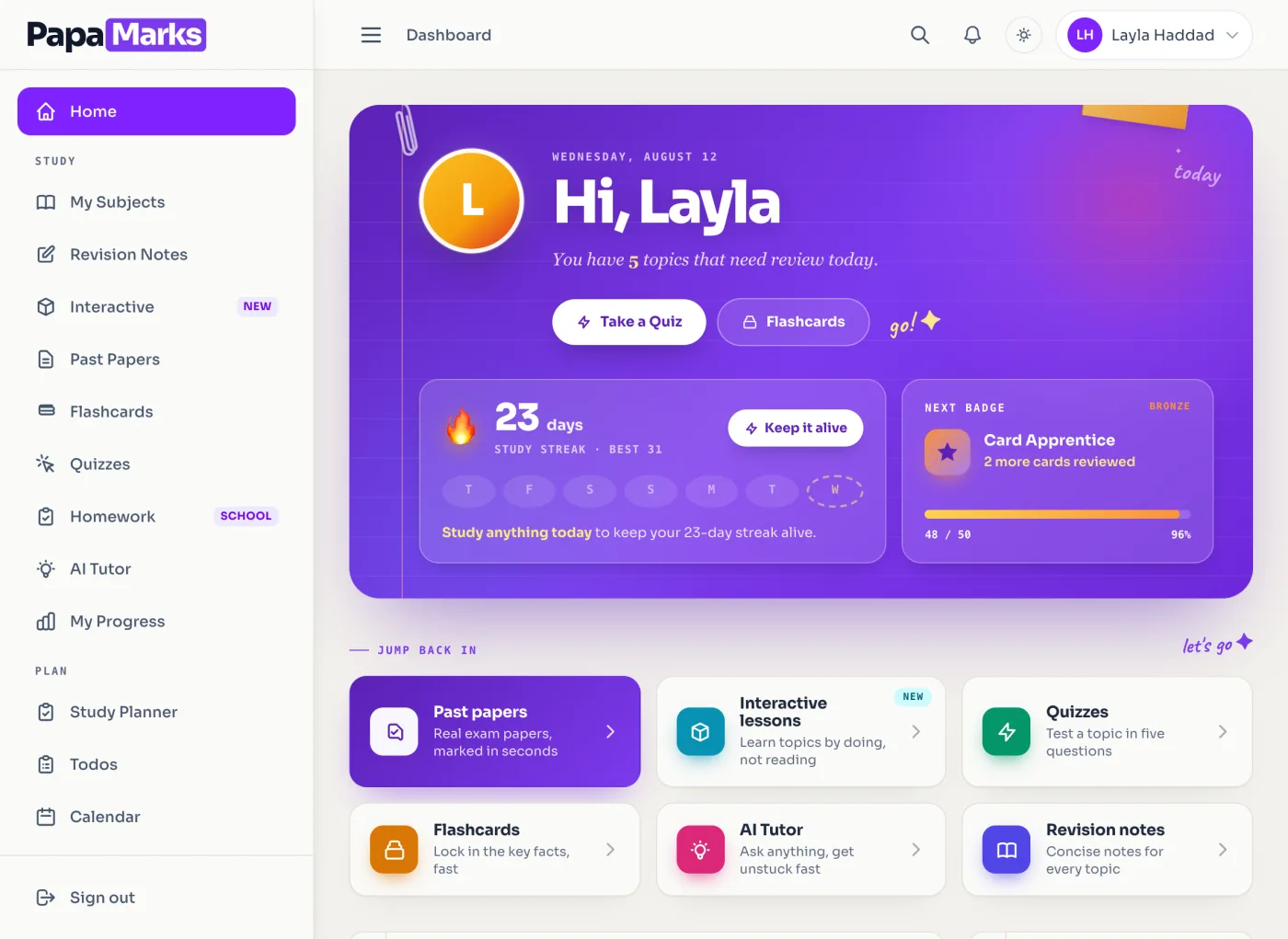
“Five topics need review today” is the whole trick. Five is small enough to start. The blank folder of nine subjects is not.
What it costs, and the conversation you will have to have
You are probably not the one paying, so here are the actual numbers to take to whoever is.
- The first topic of every subject, in full
- All 6,794 past papers with mark schemes
- Flashcards, quizzes and the study planner
- Two interactive tools in every section
- 5 AI tutor messages a month
- Every topic, in all 25 subjects
- Multiple-choice past-paper practice, marked instantly
- All 730 note sets and 104,281 flashcards
- All 131 interactive tools
- Predicted grade and the progress page
- Everything in Basic
- 87,811 written past-paper questions, marked like an examiner
- Photograph your working and have it marked
- Unlimited AI tutor on every topic
- Worked solutions and answer explanations
Start on the free tier tonight and you can see the whole thing working before anyone spends anything: first topic of every subject, and all 6,794 papers.
Where these numbers come from
224,647 questions, of which 87,811 are written answers with a mark scheme, across 3,790 topics and 25 subjects.
- Method
- Direct row counts from the live question bank, excluding disabled questions. The written figure additionally requires an official answer and a syllabus topic — a question missing either can never be marked or reached, and counting the raw question type overstates it by roughly 7,000.
- Source
php artisan site:statsagainst production.- Date
- 11 August 2026. The figures rise as content is imported; the platform derives them at render time rather than hardcoding them.
The questions people actually ask
How many past papers should I do before an IGCSE exam?
Why do I lose marks when I knew the answer?
What does PapaMarks cost?
Does it cover Edexcel as well as Cambridge?
Can I use it on my phone?
Is it worth it if I only need one subject?
Does the AI tutor just give me the answer?
Do the one thing on this page that matters
Scroll back up and spin the heart model. Answer another quiz question. Read the examiner comment on the marked answer again, properly this time.
If none of that told you something you did not know about how marks are awarded, this is not for you and you have lost four minutes. If it did — that gap is your grade, and it is fixable in a way that revising harder is not.
Related: how to get an A* in IGCSE · how to revise for IGCSE · why spaced repetition beats re-reading
Parent reading over their shoulder? The same tour, written for whoever is paying.
Put this into practice on real papers
6,822+ past papers, flashcards and an AI tutor for O Level, AS & A2. The open plan covers the first topic of every subject, plus every past paper.
Start practising →